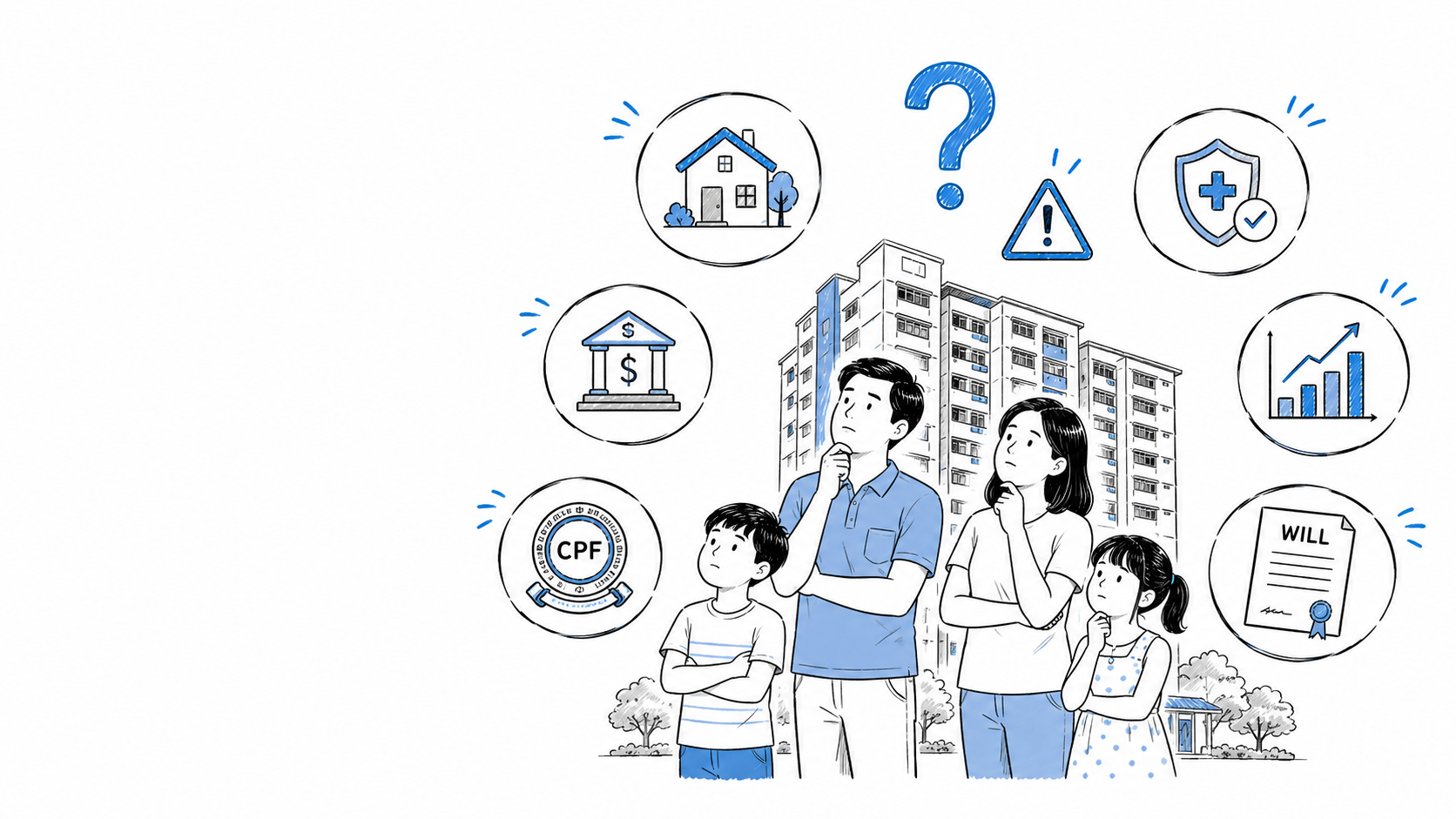

Most people do not like to talk about death.
Understandable.
But whether we talk about it or not, the problem does not disappear.
If you die without a will, your family still has to deal with your money, property, bank accounts, documents, CPF matters, insurance, investments, and whatever loose ends you leave behind.
And they have to do it while grieving.
That is where things can get messy.
A lot of people assume that when they pass away, everything will naturally go to the “correct” people.
Spouse.
Children.
Parents.
Whoever they were closest to.
But that is not how it works.
If there is no will, your estate is distributed according to the law. Not according to what you casually told someone before. Not according to who looked after you the most. Not according to what your family thinks is “fair”.
The law follows legal relationships.
Not feelings.
And this is where problems start.
The common assumption

Many people think:
“If I die, my spouse will get everything.”
Or:
“My children will settle it among themselves.”
Or:
“My family is okay one. They won’t fight.”
Maybe.
But also, maybe not.
Families can look peaceful when everyone is alive.
Once money, property, old resentment, grief, and unclear instructions come in, the mood can change very fast.
Sometimes it is not even about greed.
Sometimes it is confusion.
Sometimes it is different expectations.
Sometimes one person thinks they should have more say because they paid more.
Another person thinks they should have more say because they took care of the deceased.
Another person thinks they should have more say because they are the spouse.
Another person thinks they should have more say because they are the child.
Everyone has their own logic.
Without a will, there is no clear instruction from the person who died.
So people start arguing over what they think the person “would have wanted”.
Good luck proving that.
What happens if there is no will?

If you die without a valid will, this is called dying intestate.
For non-Muslims in Singapore, the estate is generally distributed under the Intestate Succession Act.
For Muslims in Singapore, Muslim inheritance law applies.
This article is not legal advice. Estate matters can get complicated, especially when property, nominations, joint ownership, business assets, or family disputes are involved.
But the basic point is simple:
No will means you do not decide who gets what.
The law decides the default distribution.
Sometimes that default distribution may be fine.
Sometimes it may be very far from what you actually wanted.
Simple family does not mean simple outcome
Take a basic example.
A person dies and leaves behind a spouse and children.
Many people think the spouse gets everything.
Not necessarily.
Under Singapore intestacy rules for non-Muslims, if there is a spouse and children, the spouse gets a share and the children get a share.
Sounds simple on paper.
But real life is not a neat spreadsheet.
What if the main asset is the HDB flat?
What if the spouse wants to continue living there?
What if the children want to sell?
What if one child needs money urgently?
What if one child says, “I never agreed to sell”?
What if the deceased had children from a previous marriage?
What if the current spouse and the children already do not get along?
The legal percentage is only one part of the problem.
The actual headache is control.
Who decides?
Who signs?
Who manages?
Who pays?
Who gets to stay?
That is where things drag.
The real problem is not just who gets how much
When people talk about inheritance, they like to focus on percentages.
Spouse gets how much.
Children get how much.
Parents get how much.
Who gets nothing.
But in real life, the bigger problems are usually more practical.
Who handles the paperwork?
Who applies to administer the estate?
Who contacts the banks?
Who deals with the flat?
Who decides whether to sell the property?
Who pays maintenance fees, tax, insurance, loans, or other ongoing expenses?
Who keeps the sentimental items?
Who has access to documents and passwords?
Who speaks on behalf of the deceased?
If these things are not clear, even a small estate can become a big family problem.
So estate planning is not just about money.
It is about reducing the mess for the people left behind.
Blended families can become very complicated

This is where many people underestimate the issue.
A straightforward family is already not always straightforward.
A blended family is another level.
For example:
Someone remarried.
There are children from a previous marriage.
There are stepchildren.
There is a current spouse.
There are adult children who may not be close to the current spouse.
There are elderly parents who may still depend on the deceased.
There may be a partner who was emotionally close but not legally recognised in the same way.
This type of situation can become very sensitive.
One person may say:
“I am the spouse. Of course I should have priority.”
Another may say:
“We are the children. This was our parent’s asset.”
Another may say:
“I was the one taking care of him all these years.”
And honestly, each person may feel they are being reasonable.
That is the problem.
When there is no will, everyone argues from their own version of “fair”.
But the law may not match anyone’s idea of fair.
It only follows the legal structure.
Not all assets are easy to divide

Cash is easy.
If there is $100,000 and it has to be split, then at least the maths is clear.
But many assets are not like that.
A house is not easy to split.
A business is not easy to hand over.
Investments need someone to decide whether to hold or sell.
Personal belongings can create emotional fights even if they are not worth much.
A watch.
Jewellery.
Old photos.
Religious items.
A car.
A family flat.
Some things have more emotional value than market value.
That is why the question should not just be:
“How much will each person get?”
The better question is:
“What problems will this asset create after I am gone?”
Because sometimes the asset itself becomes the problem.
What a will can do

A will gives instructions.
It does not make death less painful.
But it gives your family a clearer starting point.
A proper will can state:
- Who should receive your assets
- Who should manage your estate
- Who gets specific items
- How the estate should be divided
- What happens if a beneficiary passes away before you
- Who you trust to carry out your wishes
This matters because if you do not leave instructions, people will fill in the blanks themselves.
And different people will fill in the blanks differently.
That is usually where the fighting starts.
A will gives clarity.
Clarity does not solve everything.
But it helps.
What a will cannot do

A will is not magic.
It cannot guarantee family harmony.
It cannot stop every dispute.
It cannot fix broken relationships.
It cannot make everyone happy.
It may also not cover every type of asset, depending on how things are structured.
Some assets may be affected by nominations, joint ownership, trust arrangements, or other legal rules.
So the point is not:
“Write a will and everything will be perfect.”
The point is:
“Write a will so your family has fewer things to fight over.”
That is already a big improvement.
The hard truth
Estate planning is not really for you.
You will not be around to deal with the mess.
It is for the people you leave behind.
You are not writing a will because you expect your family to fight.
You are writing one because your family should not have to guess.
You are not planning because everyone is greedy.
You are planning because grief plus paperwork plus money is a terrible combination.
And this is not only for rich people.
Ordinary families can also have serious problems.
A HDB flat.
Some savings.
Insurance payout.
CPF matters.
A small business.
A few investments.
Even when the estate is not huge, the trouble can still be huge.
Sometimes the family is not fighting over millions.
They are fighting because nobody knows what should happen next.
3 things to remember

First, if you die without a will, you lose control over how your estate is distributed.
Second, the more complicated your family structure, the more important written instructions become.
Third, planning while you are alive is much easier than making your family sort it out after you are gone.
Nobody likes to talk about death.
But avoiding the topic does not protect your family.
It just passes the admin, confusion, and possible fighting to them.
Usually, to the people you were trying to protect in the first place.
Disclaimer
This article is for general information only and is not legal advice. Estate planning can be different depending on religion, family structure, asset ownership, CPF nominations, insurance nominations, property ownership, and other legal arrangements. If you need advice for your own situation, speak to a qualified professional.

Leave a Reply